How Multi-Agent AI Improves Decision-Making in Complex Business Workflows

Michael Yushchuk
Head of Data Science
Trying to cram the entire quarterly report and market analytics into a single prompt and expect to get expert-level insights is the same as hiring a Nobel laureate to be your CFO, legal counsel, and system architect simultaneously. That’s what organizations ask of their AI today.
The problem is that real business workflows are multidimensional and highly conditional. A single LLM with context limits and a lack of long-horizon reasoning can barely keep the logic of a ten-step compliance validation process. Even the most powerful model will be conceptually overwhelmed and eventually hallucinate under the sheer weight of contradictory instructions.
That’s why we can see the growth of multi-agent AI solutions. The distribution of conflicting and context-heavy tasks between several specialized agents, all coordinated using orchestration layers, enabled the companies to approach more closely what they seek — operational autonomy.
The article explains how multi-agent systems work, where they deliver the most value, and what it takes to build one.
What Multi-Agent AI Is and How It Thinks
An autonomous software agent is an AI with decision-making ability and a sense of purpose. It can reason about intent and choose the best course of action to achieve an objective. Each agent owns a specific, narrow function like sentiment extraction or regulatory cross-referencing using only the tools and data required for that specific task.
AI agents can autonomously manage the entire data-to-decision workflow, leveraging necessary toolsets to double-check outputs and finish tasks that would otherwise take several specialists and days of back-and-forth alignment.
When we talk about multi-agent AI for complex workflows, we describe a network of autonomous agents, each responsible for particular subtasks, that collaborate and coordinate to hit a common target. In this multi-agent system (MAS) architecture, the orchestration layer that manages sequencing and conflict resolution between agents defines the quality of the final deliverable.

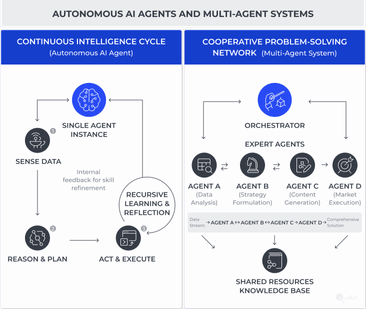
Three factors make multi-agent systems more reliable compared to single-model deployments:
- Autonomy. Each agent pursues its assigned function and doesn’t need human direction, which reduces operational overhead.
- Concurrency. Agent-based systems process different aspects of a problem space in parallel, drastically cutting time-to-insight for data-intensive operations.
- Collective intelligence. Thanks to internal validation and iterative refinement, MAS produces more accurate and nuanced results than a single model.
Essentially, multi-agent systems mimic the work of high-performing specialists, where each has a defined role, with one being a skeptical validator to hunt for logical inconsistencies.
Why MAS Improves Decision-Making at Every Step of the Workflow
Understanding when to use multi-agent systems comes down to matching your AI architecture to the complexity of your business logic. You’ll see the most value when your workflow needs to compress days of analysis into minutes of parallel reasoning with a verifiable conclusion. It becomes the right choice when:
- The order and nature of subtasks must change in real time based on new data or agent outputs. If, let’s say, during sentiment analysis an agent detects churn risk, it might decide to re-route the lead from a marketing nurturing to a negotiation agent.
- A problem is too broad and can be divided into distinct areas of expertise. Consider a real estate investment analysis, where one agent scans legal permits, another builds a 10-year financial projection, and a third assesses demographic trends.
- Multiple analyses and actions must run at the same time, such as in supply chain disruption, where agents monitor inventory, financial risk, and legal contracts.
- Outcomes demand vetting and redundancy, with agents cross-checking each other’s work to get the results you can trust.
- Workflows are long-running or asynchronous, requiring persistent state across hours or days, like the ones you can find in managing hiring pipelines.
The easiest way to evaluate the need for MAS adoption is to examine your current information flow for broken links in the reasoning chain. If, at some point, context gets lost or someone’s involvement is needed to verify or fix inconsistencies, building MAS will remove those broken parts and optimize the workflow.
Several design principles explain how multi-agent systems improve decision-making.
Parallel Reasoning
Since the agents within the MAS don’t need to wait for one another to finish a subtask, the time-to-insight is cut dramatically. In a due diligence scenario, multiple agents can audit different contract types, driving performance by over 80%, as research shows.
Decomposition of Complexity
Breaking workflows into smaller, scoped tasks spreads the load across different agent types, which often improves output quality and makes every subtask easier to audit.
Built-in Validation
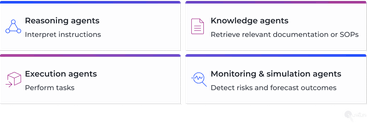
MAS enables peer review, where agents verify each other’s output for accuracy, consistency, adherence to brand guidelines, etc. The creation of dedicated validation agents can further tighten the margin for error. It’s also possible to implement multi-perspective validation for high-impact tasks like fraud detection in finance.
Ultimately, multi-agent workflows help businesses accelerate and enhance decision-making by covering broader problem-solving scopes and delivering pre-validated outputs that decrease the time for manual review, which makes AI adoption expensive at enterprise scale.
Architectures for Seamless Enterprise Multi-Agent AI Deployment
For MAS to work in real-world business environments, it’s vital to develop a governance framework that fruitfully balances agents’ autonomy, coordination, and accountability. Because if one of those aspects dominates, you risk spiraling API costs or significant latency bottlenecks.
Let’s discuss the most effective and popular multi-agent system architecture patterns that let companies keep operational risks under control.
Orchestrator-Agent Model
In this model, a central agent or orchestrator coordinates all agents. It breaks tasks into scoped subtasks, assigns each to the appropriate agent, manages sequencing and dependencies, and consolidates outputs into a final result. Every agent’s communication passes through the orchestrator. Production benefits it offers are:
-
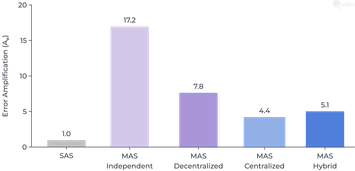
Lower error amplification through central validation and isolation of inaccuracies.
-
Simplifies debugging as development teams can certainly say which inference step in the reasoning chain failed and push a targeted fix without risking the entire system’s stability.
-
Predictable scaling path, with controlled token usage and easier integration of new agents.
Overall, centralized orchestration lowers error propagation compared to decentralized agent networks, particularly in workflows with five or more sequential decisions.
Hierarchical Architecture
A hierarchical structure is a multi-level organization of agents with assigned tiered roles and responsibilities, similar to a human leadership team. Higher-level agents decompose problems and delegate them to lower-level specialized agents, with each level responsible for a defined scope. Benefits include:
- Controlled decision cascades
- Domain-locked logic
- Granular output auditing
Hybrid Model
Preferred by large organizations, a hybrid structure combines centralized coordination with decentralized execution capabilities. There is also a central orchestrator for managing high-level workflows, but the agents have substantial leeway to manage their areas of expertise. This enables:
- Parallel expertise execution
- Fault tolerance throughput
- Adaptive workload balancing
This architecture brings discipline to production-grade LLM-based systems, necessary to stay reliable under high load and complex data conditions.
Failure Modes of Multi-Agent Systems
While decidedly superior for complex problem-solving, MAS is not a universal solution and can become counterproductive in certain scenarios. Below, we describe the main limitations of multi-agent systems that may degrade performance or simply not suit your case.
Sequential Workflows
The performance case for MAS is built on parallelism. Applied in workflows with a strict, step-by-step logical sequence, MAS will add coordination costs with no concurrency benefit. Research from Google & MIT shows that performance can drop by 39-70% compared to optimized single-agent pipelines.
Coordination Overhead
Every additional agent increases communication overhead, orchestration complexity, and multiplies the risk of routing errors. When a certain threshold is passed, agents spend more “cognitive budget” on intercommunication and conflict resolution than on solving the actual problem, leading to a massive drop in overall system efficiency.
Cascading Failures
A single hallucination early in the reasoning step poisons the input for downstream agents. By the time the error reaches validation, the cascade may already be irreversible. This is the most operationally dangerous failure in production MAS to avoid, which requires strong validation layers and centralized control that can contain error amplification to 4.4x.
Contrary to common belief, production-grade MAS reliability largely depends on knowing when to simplify workflows rather than over-optimizing for autonomy.

Industry-Specific Use Cases for MAS
Theoretical advantages aside, the real reason organizations invest in multi-agent workflows is to automate what was considered not automatable just recently. Implemented properly and for correct workflows, a well-orchestrated MAS will pay off in no time.
Finance & Investment Analysis
Finance is a leading adopter of MAS for high-stakes decision-making and large-scale data processing. Specialized agents decompose intricate financial models into autonomous subtasks.
We applied this approach for an Israel-based financial analytics firm that needed to evaluate 9,000+ publicly traded companies across 7 regions, each demanding 100+ sector-specific parameters alongside macroeconomic context. To build an AI investment analysis, we designed a multi-agent pipeline broken into:
- Sector modeling. Structuring data by GICS sectors.
- Live context integration. Using Gemini with real-time search to ingest market signals from sources like Bloomberg and CNBC.
- Macro-matching. Aligning companies with regional economic narratives.
MAS deployment led to a 75% reduction in manual research time, replacing the repetitive workload of four full-time analysts through automated investment scoring.
Healthcare Systems
In clinical decision support, multi-agent AI enables simultaneous analysis of patient history, current diagnostics, drug interactions, and treatment guidelines, unattainable by a single model. With the help of MAS, practitioners can reach deeper diagnoses at near-instant speed and back decisions by a 360-degree synthesis of clinical data.
Supply Chain & Logistics
Organizations use MAS to manage logistics with greater resilience and adjust quickly to demand volatility. Agentic-powered predictive maintenance becomes more autonomous, while route optimization benefits from multi-source data streams. In case of disruption, the orchestrator reroutes all agents to work on that problem.
Our Engineering Approach to Production-Ready Multi-Agent AI
The way you approach the problem defines the throughput and scalability of your AI workforce. Teams learning how to build multi-agent AI systems tend to start with the model choice, ignoring workflow logic. In a production environment, the workflow structural demands come first, and that’s where we always start our development cycle.
1. Define the workflow needs
We map your business process end-to-end to determine every decision point, dependencies, and where you face friction to guide the workflow structure.
2. Identify parallelizable tasks
We find tasks that must run sequentially and simply them to lean, automated pipelines. And separate those that can run concurrently or need diverse expertise to distributed agent roles.
3. Define agent roles
We structure MAS using three core agent types that form a self-correcting execution cycle:
- Planner, responsible for decomposing the high-level prompt into discrete instructions and managing task routing;
- Executors to perform scoped, specialized functions against defined tools and data sources;
- Validators to audit outputs against grounding data to prevent drift.
Role ambiguity at this stage is the most reliable predictor of coordination failure downstream.
4. Use orchestrator-first architecture
To minimize coordination costs, we use a centralized orchestrator because it allows for strict state management and early-exit conditions if a hallucination is detected. We continuously review agent count and interaction patterns to see if they are justified at particular execution cycles.
5. Integrate into production
We integrate MAS into your existing infrastructure, leveraging AWS Glue, PySpark, or high-performance vector databases to ensure data flows seamlessly from ingestion to insight.
The Bottom Line
Multi-agent workflows are a massive leap in strategic decision-making, taking on a lion’s share of managing increasingly complex processes. Get the MAS architecture right, and the system operates with surgical precision. Get it wrong, and no model upgrade will fix the coordination aspect of the solution.
The competitive advantage in AI doesn’t lie in the most powerful model, as it has never been. True proprietary value that is hard to replicate is an effectively designed and well-orchestrated LLM-based system that shows predictable results, no matter how demanding the production environment is. If you share the same results-driven mindset and seek a sustainable market edge, we invite you to discuss your needs and AI opportunities for your business.