LLM Deprecation and Migration Strategy: How to Adapt to Rising AI Prices

Ruben Melkonian
CEO
Model retirement is a structural reality of the AI market, not a rare operational event. OpenAI (GPT), Anthropic (Claude), Google (Gemini), and other LLM providers frequently deprecate specific API versions in favor of newer models.
The biggest mistake is treating these models as permanent commodities. In a production-ready system, prompt logic and output stability are often optimized for the unique behaviors of a specific model.
Therefore, when a provider decides to retire a model, it forces an unexpected migration, even if your system is performing flawlessly and generating revenue. Losing a foundational model triggers a mandatory cycle of regression testing and recalibration for a new one. Building for reliability requires an explicit strategy, because the impact of these forced migrations is multidimensional:
- Financial – direct price increases compound at scale. Even modest percentage shifts materially affect high-volume systems.
- Operational – migrations consume engineering capacity that could otherwise drive product growth.
- Technical – nondeterministic outputs make regression validation complex, especially for generation-heavy systems.
- Strategic – heavy dependence on a single large model increases vendor lock-in and reduces negotiation leverage.
In this article, we will go through the effective practices from a personal experience that can help you survive a provider’s retirement cycle while maintaining system stability.
Why LLM Deprecation Is a “Hot” Topic for Engineers
From a technical perspective, the frustration is simple: systems work until they are forced to change.
In a traditional AI solution, when you train a model and deploy it to production, it doesn’t end here. You constantly monitor it, track quality metrics, and retrain only if user behavior shifts or performance degrades. There is no reason to replace a stable, revenue-generating model.
When you train your own model, performance degradation often occurs due to data drift. For example, a custom computer vision model might fail because of the adjusted camera angle or resolution. The model didn’t degrade over time for no reason; the real-world data distribution shifted. You control the retraining process. But with API providers, the dynamic is entirely different.
When you rely on API-based LLM providers, the decision is no longer yours. Even if a model fully satisfies your requirements, the provider may deprecate it for internal reasons – cost, infrastructure load, strategic positioning. They remove the model not because it degraded for you, but because it no longer makes sense for them commercially.
You can have a healthy production environment where everything behaves predictably and still be forced to migrate. That’s why this topic generates tension inside engineering teams: the problem comes from outside the system.
These external pressures display as three primary categories of business and technical risk that every team must account for.
Business and Technical Problems Caused by Model Deprecation
1. Direct Cost Increases
Even a 5-10% price increase becomes significant at scale. A chatbot handling 10,000-20,000 requests per day amplifies every marginal change. When the difference reaches 50% or more, it reshapes the product’s entire cost model.
Providers sometimes recommend a “closest replacement,” but that model may sit in a higher pricing tier. The market has shifted from competing on price and speed to competing on quality, with noticeably higher costs.
Market dynamics have also shifted. Earlier competition emphasized speed and aggressive pricing. Today, providers compete primarily on quality improvements – often introducing newer models at noticeably higher price points. In some generational transitions, price differences can approach 2x. For instance, generational leaps in models like Gemini can nearly double pricing. The harsh reality of vendor dependency is simple: you just have to accept it, or change the vendor. However, changing vendors isn’t the only way to protect your margins. You can also implement a cost-saving architecture to minimize expenses without sacrificing quality.
2. Migration Costs & Efforts
Changing an endpoint is trivial – you just change the URL. Adapting behavior is not.
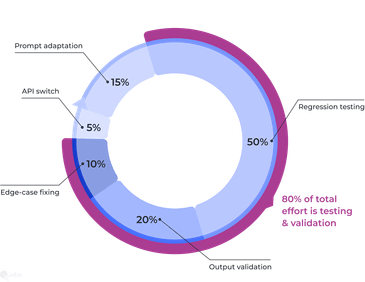
The majority of time in migration is spent not on switching APIs but on:
- Prompt adaptation
- Regression testing
- Structural validation of outputs
- Fixing edge cases
In large systems, subtle changes in output structure may go unnoticed initially. The system technically works, but formatting differences or minor behavioral shifts may break downstream logic.
From personal experience, roughly 80% of the migration effort is spent on testing and refining prompts based on quality checks. And unlike classical software systems, LLMs are nondeterministic. You cannot rely on binary input-output comparison. Two valid answers may differ in wording, but both are acceptable, which complicates automation.

3. Business Risk
Even with provider guidance, a new model always behaves differently. Migration introduces uncertainty:
- Response structure may shift
- Tone or reasoning patterns may change
- Edge-case handling may differ
These risks may be inherent to the current market, but they don’t have to be a disaster. The following three pillars form the foundation of a migration-ready strategy.
Testing and Migration Strategy
A structured approach reduces risk but does not eliminate it.
1. Maintain a Regression Dataset
Every production system should have a stable set of evaluation examples:
- For chatbots: question-expected-answer pairs
- For classification: labeled samples
- For structured outputs: format validation cases
Every model update should be validated against this dataset. If quality does not degrade, migration becomes safer.
Classification tasks are relatively easy to validate because you can simply compare predicted labels (e.g., classes 1-5). Generation tasks are significantly harder because outputs are variable by design.
Since standard unit testing (e.g., assert output == expected) fails on generative text, engineering teams must implement specialized evaluation pipelines:
- LLM-as-a-Judge: Use a larger, highly capable model to grade the output of the new model against a strict set of criteria. You can ask the judge model: “Does Candidate B contain all the factual information present in Baseline A, without adding hallucinations? Answer Yes/No.”
- Semantic Similarity Scoring: Convert the old model’s expected output and the new model’s actual output into vector embeddings. If the cosine similarity score is high, the new generation is semantically acceptable.
- Deterministic Guardrails: Evaluate the structure, not the free-form text. Use code-based checks to ensure the model outputs valid JSON or includes mandatory keywords.
2. Design Model-Agnostic Prompts
One practical recommendation: avoid overfitting prompts to a specific model. It occurs when developers lean into the specific quirks of one model (such as Claude’s heavy reliance on XML tags vs. GPT’s preference for Markdown).
For instance: if you are building with a new Gemini model, don’t test it alone. Run a suite of 100 test cases simultaneously across Gemini, GPT, and Claude models, using identical regression tests and adjusting your prompts to minimize differences between the models. Generate a summary table of passes and fails across all models. By doing so, you drastically future-proof your system and reduce future migration time.
The goal is not to fully abstract away differences, but to ensure approximate behavioral stability across providers. This reduces future switching costs.
3. Decompose Complex Tasks
Instead of solving everything in a single large model call, break tasks into smaller steps:


LLM APIs charge for tokens, not the number of calls. Splitting tasks does not significantly change total token usage but allows you to use simpler and cheaper models for subtasks. If you take a heavy task, like finding relevant articles, filtering them, summarizing, and translating – break it into four separate API requests, your total token count remains roughly the same. However, since you can route the simpler filtering and translating steps to much smaller models, your overall cost per token drops significantly.
Your benefits? Lower costs, greater flexibility, easier replacement if one model is deprecated, and access to open-source or self-hosted, cost-effective alternatives, like Llama, Mistral, etc., as well as:
- Self-Hosting: You gain absolute permanence by hosting open-weights models on your own infrastructure.
- Specialized Hardware APIs: Alternatively, you can use companies, like Groq, that build custom Language Processing Units (LPUs) – silicon chips designed specifically to accelerate language model inference. This allows you to access open-source models via API at blistering speeds (400+ tokens per second) and at a fraction of the cost of flagship proprietary models.
If your architecture depends on one costly “super-model,” you’re basically locked in. If tasks are decomposed, the number of replacement options expands. However, once your architecture is modular, the challenge shifts to selection: how do you identify which model is the right fit for your specific subtasks?
Evaluating Alternatives and Comparing Providers
Public dashboards, like Artificial Analysis, compare model speed, reasoning ability, and pricing. These benchmarks are directionally useful: a top-ranked model will generally outperform a low-ranked one.
You may rely on it as a source that helps to identify which models fall into the same performance tier as the one you are currently using.
However, differences between neighboring models are often marginal and task-specific. If two models have close benchmark scores (e.g., 48 vs 47), the public rankings don’t matter that much. Real-world performance will depend entirely on your specific use case. Benchmarks use neutral tasks; your workload may behave differently. Often the most effective strategy to cut AI operational costs is to select models proportionate to the task, using smaller, fine-tuned models for domain-specific tasks rather than defaulting to expensive flagship LLMs.
Your strategy is the following:
- Use rankings to shortlist candidates.
- Always test models on your own regression dataset before integration.
At the same time, actively track model lifecycle announcements. Providers typically publish retirement timelines in advance. To use this information effectively, you should integrate these timelines into a broader strategy for observing market trends and internal quality metrics.
Automated Market Monitoring and Switching
Unfortunately, there is no magic pill. What you can do systematically:
- Monitor provider lifecycle pages and deprecation timelines.
Be aware that deprecation usually happens in distinct phases: first, new users are blocked from accessing the old endpoint; next, existing users are given a grace period of a few months; finally, it is fully shut down. You are informed in advance, but you still must migrate.
- Continuously track quality metrics in production.
Establish comprehensive monitoring, traceability, and observability. Whether your application runs in real-time or processes batches asynchronously, you must log everything, track intermediate outputs (especially in decomposed workflows), and collect quality metrics over time. When quality drops, you have a baseline to investigate. Usually, degradation happens because user behavior changes or the input data shifts – a data drift. By strictly logging production metrics, you can determine whether a drop in quality is due to your users changing their behavior or to your API provider stealthily updating the model behind the scenes.
- Maintain regression tests that can be run against multiple models.
Build your CI/CD pipeline so that your automated regression tests continuously route production samples to your fallback models. This ensures that as your prompts naturally evolve over time, your fallback models remain fully compatible, and migrating remains as simple as flipping a configuration switch.
- Periodically benchmark comparable models in the same price segment.
Set up a quarterly routine to evaluate new open-source or API models strictly within your current cost-per-token limit. Because providers often push expensive flagship upgrades during deprecation events, maintaining a shortlist of tested replacements is your best strategy to avoid forced budget increases.
Migration becomes stressful when delayed. When multiple models require replacement simultaneously, the workload multiplies quickly. Proactive evaluation and staggered migration reduce pressure and operational risk. Delaying these updates can be devastating. In real-world enterprise systems running upwards of 15 models simultaneously, a forced deprecation event can easily consume 1 to 1.5 human months of purely reactive, non-feature engineering work.
Model Deprecation Is a Structural Reality, Not an Exception
There is no single technical trick that eliminates this risk. What works is discipline in system design:
- Assume replacement is inevitable. Build architectures that tolerate switching.
- Continuously monitor quality metrics. Degradation detection should be standard practice.
- Maintain robust regression datasets. Especially for generative systems.
- Decompose complex workflows. Smaller subtasks widen your model choices and reduce cost pressure.
- Benchmark alternatives proactively. Don’t wait for deprecation announcements.
The most resilient teams treat model providers as modular infrastructure layers rather than permanent dependencies. In the AI market, long-term stability does not come from choosing the “best” model today. It comes from designing systems that remain stable when that model disappears tomorrow.