AI Engineering for Complex Products and Business Operations
We design, implement, and scale AI capabilities across products, workflows, and data infrastructure.
Discuss Your AI Project


Production AI Systems Built for Real Business Environments

AI Technology Consulting
AI technology CONSULTING
Define high-impact AI use cases aligned with your business goals. We provide AI strategy, technical architecture, feasibility validation, and implementation roadmaps.

AI Modernization & Integration
AI Modernization & Integration
Integrate AI into existing products, workflows, and enterprise systems without disrupting business operations.

Agentic Workflow engineering
Agentic Workflow engineering
Design and deploy AI agents and multi-agent systems that automate complex workflows, orchestrate tasks, and operate with minimal manual intervention

AI Performance & Cost Optimization
AI Performance & Cost Optimization
Improve model performance and control infrastructure costs through MLOps, evaluation frameworks, workload optimization, and scalable AI operations.

Reliable LLM Systems
Reliable LLM Systems
Implement LLM and real-time data retrieval systems to develop AI agents, co-pilots and decision support systems with precise, context aware functionality.

Data & AI Infrastructure
Data & AI Infrastructure
Design scalable data pipelines, warehouses, and AI-ready architectures that unify fragmented data into production-ready AI infrastructure.
Built on precision. Driven by impact

Certified AWS partner
- 10 years
Years building applied AI systems
- 60+
AI engineers and software developers

ISO 9001 Certified
Real Results, Real Impact
 AGRITECH
 10% Revenue Loss Reduction
 10x Less Grower Involvement
 HEALTHCARE
 Faster Analysis
 AI Diagnostics
 Decision Support
AI-Powered Investment Analysis
AI platform that transforms complex financial data into actionable investment insights.
- 82% Coverage
- 20+ Languages
- 12x Faster Reports
 20+ Languages
 Enterprise Infrastructure
Scalable Hybrid & Multi-cloud Infrastructure
Built an infrastructure platform that simplified cloud operations across hybrid and multi-cloud environments.
- Hybrid Cloud
- Automation
- Multi-Cloud
 Hybrid Cloud
 Automation
 Multi-Cloud
 MACHINERY MANUFACTURING
 3D Detection
Built to Reduce AI Delivery Risk
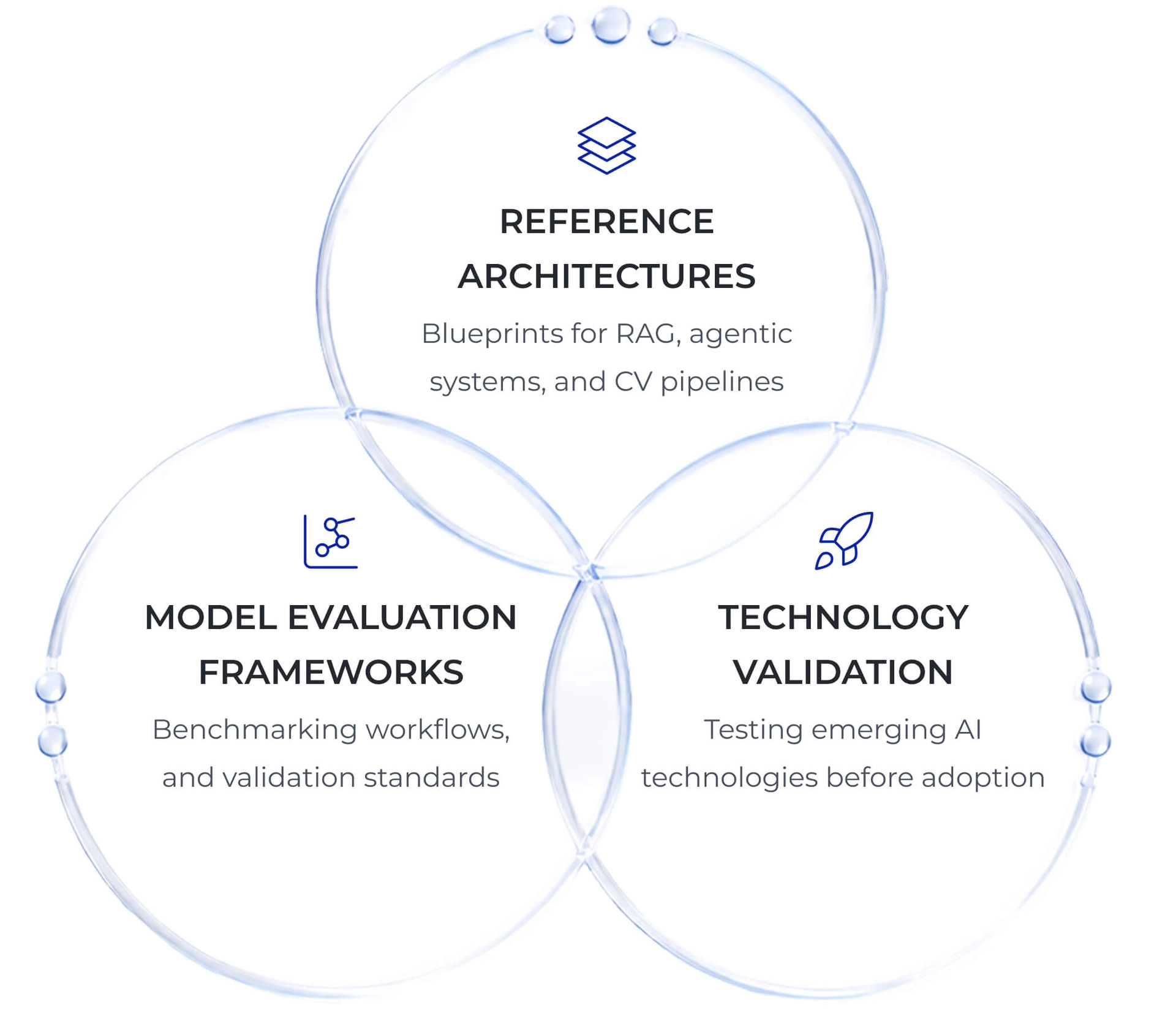
Our AI Center of Excellence continuously evaluates emerging models, frameworks, and implementation approaches to understand where they deliver measurable value and where they introduce unnecessary complexity.
The result is a growing library of proven architectures, evaluation methodologies, and validated engineering practices that can be applied across client engagements.

How Production AI Gets Delivered
Discovery & Feasibility Validation
We assess business objectives, data availability, technical constraints, and AI feasibility before committing to full-scale implementation.
1–3 weeksAI Validation & Solution Design
We validate AI approaches, benchmark models, evaluate assumptions, and design the architecture required for production deployment.
2 to 6 weeksEngineering & Integration
We build AI applications, workflows, and data pipelines, integrating them with existing platforms, products, and business systems.
6–16 weeksProductionization & Optimization
We deploy, monitor, evaluate, and continuously optimize AI systems to ensure reliable performance in production environments.
OngoingWhat Clients Say

Quantum has impressed us on several important levels. First, their depth of expertise in AI, technical precision, and understanding of our industry. Quantum’s work has resulted in an improvement in the accuracy and consistency of AI-driven financial insights, faster release cycles for new AI features, lower internal overhead.
Read moreQuantum entered the engagement with a solid structure, which helped them evaluate the best strategies and execute successfully. Their ability to propose solutions, apply their expertise, and organize the project make them unique, effective partners.
Read moreFAQ
How do you move AI systems from prototype to production?

Many AI initiatives fail after the proof-of-concept stage because production requirements are far more complex than the initial demo. Our work typically focuses on closing that gap. This includes architecture redesign, integration with existing systems, security and governance controls, performance optimization, observability, and deployment planning. We build AI systems intended for real operational environments, not isolated experiments.
How do you validate whether an AI use case can succeed under production constraints?

Before major implementation begins, we help clients assess whether an AI initiative is technically and operationally viable in a real business environment. This may include evaluating data readiness, architecture complexity, integration dependencies, governance requirements, operational risk, and expected delivery constraints. The goal is to reduce uncertainty early and determine whether the proposed initiative can deliver measurable business value under production conditions.
Can Quantum integrate AI into our existing products and infrastructure?
Most of our AI engagements involve integrating AI into existing products, enterprise platforms, and operational systems rather than building isolated prototypes. This includes connecting AI capabilities to APIs, data pipelines, legacy systems, cloud environments while accounting for performance, governance, latency, and deployment constraints. The objective is to make AI work reliably within the realities of your existing architecture.
How do you approach AI governance, security, compliance, and auditability?
Security, governance, and compliance are built into the engineering process from the start. Depending on the use case, this may include secure data handling, access controls, audit logging, approval workflows, model oversight, and deployment architectures aligned with operational and regulatory requirements. We regularly work with organizations operating under strict governance expectations, including regulated and business-critical environments. Intellectual property for custom-developed code, models, and project-specific deliverables remains with the client.
How do you monitor, optimize, and govern AI systems after launch?
We provide ongoing operational management after deployment. Depending on the solution, this may include performance monitoring, infrastructure support, model optimization, retraining, cost tracking, workflow refinement, and continuous technical improvements as usage evolves. AI deployment is rarely a one-time implementation effort, particularly for systems operating in dynamic business environments.
How do you reduce hallucination risk and improve AI reliability?
AI reliability is a systems engineering challenge, not just a prompt engineering issue. Depending on the use case, we apply multiple control layers such as retrieval architectures, structured outputs, validation pipelines, fallback logic, and continuous monitoring. For high-stakes workflows, this may include automated validation frameworks that compare generated outputs against source data, flag unsupported claims or numerical inconsistencies, and route anomalous cases for review. Reliability is treated as an ongoing operational discipline, not a one-time implementation task.
How do you design human oversight into AI workflows?
Not every AI workflow should be fully autonomous. The appropriate level of human oversight depends on the operational risk, regulatory environment, and business context. Depending on the system, we may design approval checkpoints, exception handling flows, escalation logic, review layers, or supervised decision workflows that balance automation with trust, governance, and operational control.
What factors determine the cost of an AI project?
AI development costs are determined by the scope and complexity of the solution rather than a fixed price. We evaluate factors such as the level of AI autonomy, the number of business systems that need to be integrated, the quality and governance of your data, and the AI architecture required to achieve your objectives. As a general guideline, AI assistants and chatbots typically range from $10,000 to $100,000, AI agents that interact with enterprise systems and automate business workflows usually start at $50,000 and can exceed $150,000, while enterprise AI platforms combining multiple AI capabilities, such as copilots, RAG, predictive analytics, computer vision, and deep integrations with ERP, CRM, or EHR systems, generally require investments starting from $300,000 and may exceed $1 million.



















Build AI With Confidence
Whether you are modernizing an existing product or scaling AI into production, we can help define the right architecture and delivery path.
- Discovery Before Commitment
Feasibility, architecture, budget, and delivery scope validation before committing to full-scale.
- Enterprise-Ready Collaboration
NDA support, transparent delivery, and scalable engagement models.
- In-House Senior Engineering Team
Experienced AI, ML, data, and software engineers who stay involved from discovery through production.