AI Consulting: How We Build Profit-Oriented Implementation Roadmaps

Ruben Melkonian
CEO
Why do 95% of AI pilots never reach production deployment even when the early results look promising? As MIT’s State of AI in Business Report states, it has nothing to do with model complexity or regulation, but an approach.
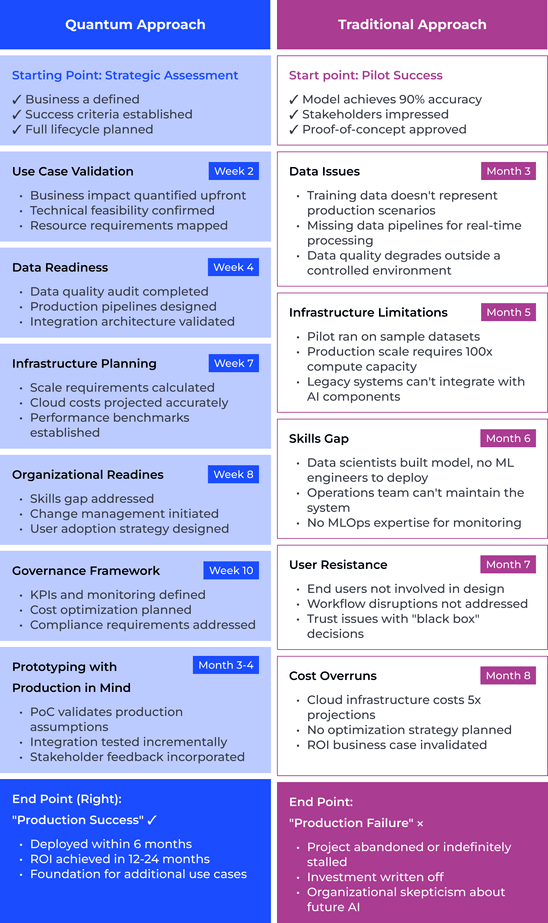
While everyone is talking about AI’s high potential, very few discuss the risks that lie between a working prototype and an operational system. The pilot-to-production gap is the most expensive failure mode in AI implementation. Organizations invest months in building proofs of concept that demonstrate technical feasibility, yet are unable to generate returns or deliver measurable impact.

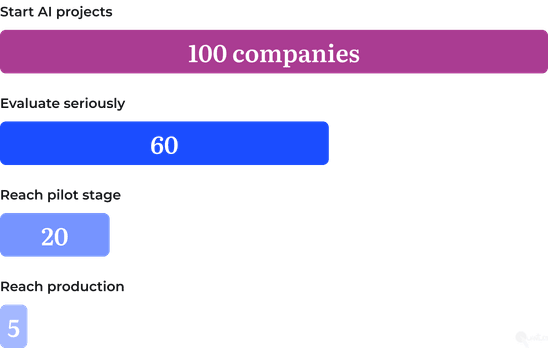
Our experience shows that AI strategy consulting services help organizations close this gap in 100% of cases and successfully plan for production requirements. That said, we want to share a practical roadmap you can apply to your current or upcoming AI initiatives to secure predictable execution, and most importantly, long-term value.
The Anatomy of a Rock-Solid AI Roadmap
Organizations start AI implementation very enthusiastically, but too often don’t have the systemic framework or governance discipline that allows steady progress. According to McKinsey’s 2025 State of AI report, only 6% of companies qualify as “AI high performers,” capturing at least 5% of EBIT from AI initiatives. The quality of strategic planning is the main differentiator when it comes to quantifying ROI.
Over the years of consulting businesses regarding AI adoption, we’ve formed and refined the approach for validating readiness across strategy, infrastructure, organizational capability, and governance dimensions. Let’s review in more detail how to build a winning AI implementation framework.

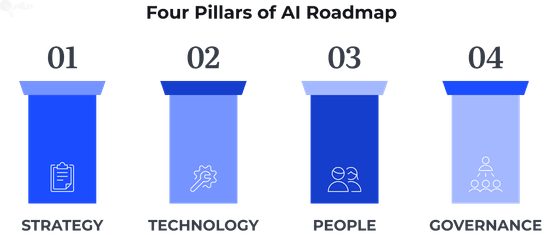
Strategic Use Case Prioritization
You may have heard it many times, yet mapping AI projects to core business priorities is the first and most paramount step in the whole process. Although you can verify AI’s technical feasibility without it, it’s simply impossible to justify continued investment since you’ll have no idea what and to what extent the adopted technology has improved.
Another critical point of failure we see is the inability to determine where AI use will show the highest return on their specific business model. The excitement around AI can produce dozens of potential applications in customer service, finance, product teams, operations, and other business units. However, pursuing too many initiatives simultaneously stretches your resources and effort too thin.
For this reason, you have to narrow the list to the most promising use cases that can realistically be delivered with your existing capabilities. To do it, follow these steps:
- Identify all candidate use cases proposed by business units or technical teams.
- Estimate the business value of each in terms of cost savings, revenue opportunities, risk reduction, customer impact, etc.
- Assess execution feasibility, including data availability, technical complexity, integration needs, and possible risks.
- Rank use cases by a combined score of value × feasibility.
- Select 1-2 top initiatives to pilot or prototype.
Here’s a sample table you can use to estimate the most promising use cases

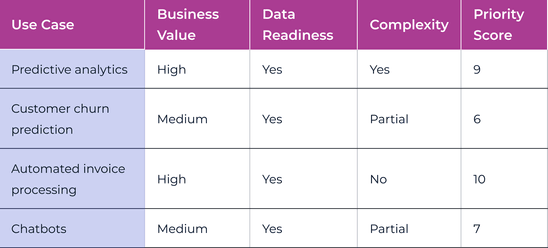
Notes:
- Priority Score is calculated using a formula: Business Value × Data Readiness × Complexity Factor or a weighted scoring system.
The point is to move from conversations, “we should do something with AI,” to concrete outcomes and a strategically aligned plan on how to implement AI. It requires deep analysis and collaboration of various departments that typically speak different languages and optimize for different objectives. This is where real difficulties hide. In this context, AI strategy consulting can remove this burden and specify what to build, in what order, and why.
Data and Technology Stack Assessment
The painful reality companies confront too late is that even the most perfect AI algorithms can’t produce the expected outputs without quality data. Even worse, 85% of AI models fail primarily due to insufficient relevant data or poor-quality data.
If you don’t want to become another statistic, assessing your data AI readiness as well as checking whether your infrastructure can cope with production-grade workloads is your best move.
Here’s a list of what needs to be done:
- Data quality audit. Under quality data, we mean data that can be characterized as complete, consistent, accurate, relevant, unique, and timely. Understand what percentage of records contain errors, miss values, or are inconsistent, how frequently the data is updated, and what format it’s stored in.
- Data accessibility and integration check. Too often, companies discover that data nominally available is practically inaccessible due to system architecture, data governance policies, or interdepartmental barriers. Therefore, first of all, you should learn whether the required data exists within your organization. Then, examine how fragmented those sources are and whether they can be accessed and extracted without workaround chains or manual intervention.
- Infrastructure preparedness. Your existing systems must be able to manage the computational demands and data velocity that AI and LLM-based solutions require at a production scale. Evaluate how successfully your current tools and systems deal with model training workloads, inference requests, and data processing to understand what needs to be upgraded or reconfigured.
- Security and governance policies review. For AI systems to deliver the desired results, access to sensitive data may be required, which is why setting strict security controls and governance frameworks is critically vital. Review your policies for how adequately they treat AI-specific risks like model theft and data poisoning. Equally important is to verify that governance structures describing bias detection and decision traceability are in place to avoid AI systems operating as unmonitored black boxes.
Detecting weaknesses in infrastructure or data this early gives you space to course-correct while the cost of change is still manageable. Skip this step, and as statistics show, the likelihood of failure or project abandonment skyrockets.
AI Adoption Strategy Development
Around 70% of organizations find people and process challenges as the primary obstacle to AI scaling. The Quantum team agrees with this finding, having observed how technically flawless AI and ML solutions are stuck when executive leadership neglects the human part of the equation.
Below, we provide key aspects to evaluate and plan for successful AI business integration:
- Team composition and skills. Understand whether your team has the roles and competencies to drive operational outcomes from the project. If essential skills are missing, define the gaps and decide which ones to hire, train, or engage external AI consulting experts.
- Change management and adoption. Employees must understand how AI is going to change their workflows and why it matters. That’s why it’s vital to set up a clear communication, or better a dialogue, to listen to employees’ fears and address them by explaining AI’s role and how it’s intended to improve the company’s bottom line.
- Individuals accountable for leading the change. Designate the individuals or teams who will take ownership of AI adoption and have the authority to make decisions and allocate resources. So, if someone in your company has difficulties or needs advice, they know exactly whom to turn to.
With these responsibilities being clearly defined, your chances for achieving high-level AI maturity and pervasive value from investment increase dramatically.
You can check this AI readiness scorecard template to understand how prepared your business is.

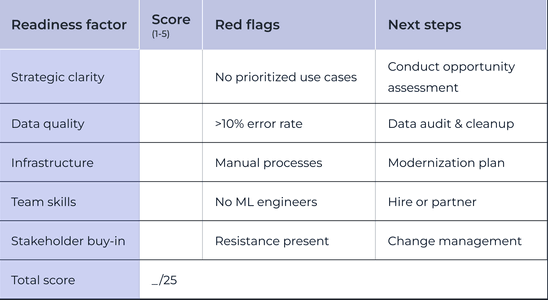
Measuring AI Vitals: KPIs and ROI
An effective AI implementation framework should outline quantifiable key performance indicators tied to business objectives so you can certainly say whether the AI initiative succeeded or not.
There are three KPI categories our AI experts recommend tracking:
- Business outcome KPIs. In a nutshell, your business KPIs reflect the main reason you decided to adopt AI in the first place. It may be time reduced to complete certain tasks, lower cost to deliver services, improved customer satisfaction due to more personalized experiences. The list goes on.
- Technical performance KPIs. Analyzing technical metrics like system uptime, model accuracy, error rates, and others will help you understand the AI system’s reliability and fix critical problems early on.
- Adoption rates. Here you can look for daily active users, feature engagement, workflow completion rates, and user satisfaction scores.
Now, let’s discuss the burning concern of all leadership executives: AI ROI.
From our experience, calculating ROI for artificial intelligence projects proved to be more complex than for traditional software investments. The main reasons are longer time horizons for realizing benefits and considerable indirect values, coupled with difficulties in isolating AI’s contribution from other factors.
So, to gauge the project’s profitability, you need to take into account all gains that add to the final result:
- Direct cost savings stemmed from lowered labor effort, decreased operational expenses, or cut capital requirements attributed to AI automation.
- Revenue increase through more sales, better pricing power, or new revenue streams enabled by AI capabilities.
- Risk minimization value appearing as prevented frauds, compliance violations, safety incidents, or operational failures.
- Long-term strategic gains, such as better customer lifetime value or reduced cycle time that don’t generate immediate ROI.
The hardest part is to convert these benefits into measurable numbers. But once done, you can apply a simple formula:
ROI = (Total quantified benefits – Total investment) ÷ Total investment
After analyzing dozens of our clients’ AI business integration cases, we found that AI initiatives typically bring positive ROI within 12-24 months. What’s more, our clients saw accelerated returns after initial deployment, as they used established frameworks and capabilities that proved their viability for new business use cases.
Quantum’s AI Consulting Framework That Delivers Results
We’ve been building an approach to AI consulting services for eight years and continue to refine it as the market and technological landscape change pretty fast. It allows us to provide targeted expertise for every stage of your AI journey.
Let’s see how exactly our framework works.

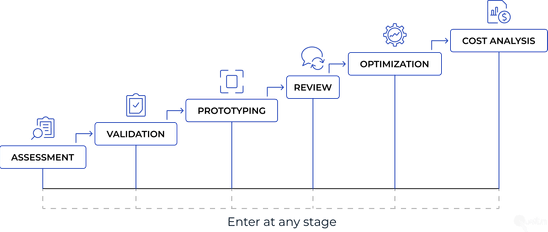
AI Opportunity Assessment
We start every engagement with the question: “Will AI help you to reach your goal?” Because it immediately gives an understanding of whether artificial intelligence is the right solution for your needs.
Then, we proceed with the analysis of your business processes and operational bottlenecks to distinguish the highest-impact opportunities for AI application. The Quantum team of specialists evaluates potential use cases from business, technical, and organizational perspectives to point out those with the strongest ROI opportunities.
Idea & Project Validation
You have an idea of using AI to automate a certain process, but have no clue what to do next. This is when we can help you test the idea in terms of feasibility, regulatory constraints, data needs, and commercial outcomes. Together, we define the scope, realistic project boundaries, success metrics, and create a project roadmap.
Prototyping
We never start full-scale AI development until we test core hypotheses and validate technical feasibility via a proof-of-concept (PoC). This way, we de-risk assumptions critical to the project’s success. A functional prototype lets you prove that data supports the intended use case and algorithms can achieve the necessary accuracy with minimal investment.
AI Model Evaluation
We run scenario-based and stress tests to review model behavior in action and assess how well it matches your performance expectations: accuracy, drift resistance, fairness, explainability, and robustness. On top of standard metrics, we examine downstream risks such as hallucinations and model degradation over time.
Architecture & Code Review
When companies plan to move AI prototypes into real-world environments or certify for industry standards, architecture and code review are very welcome. We assess your pipeline architecture, ML engineering workflows, and code quality to recognize issues while they’re still small and inexpensive to fix.
Performance Optimization
If your AI product underperforms or can’t scale, finding out the root cause will require scrupulous inspection. Equipped with the latest tooling for profiling, tracing, and load analysis, our engineers will investigate every possible pressure point in inference paths, data flows, model choice, and design a path to stable and efficient performance.
Cost-effectiveness assessment
With the rising cloud and API expenses, AI cost reduction tactics become invaluable. Given that, we help organizations optimize their spending on infrastructure, AI model APIs, supporting tools, and operational overhead to preserve the same quality of outputs at a lower cost.

TrackSense Case: AI Strategy Consulting That Saved Migration Costs
Anticipating your doubt about how AI consulting services can save you money or bring a positive outcome you can measure, we propose examining one of our clients’ cases.
TrackSense, a leader in drone-based rail infrastructure monitoring, faced a high-stakes technology decision critical to their operations.
The core challenge lay in their photogrammetry workflow, which included processing aerial imagery datasets and analyzing them using AI to detect anomalies and condition changes and enable predictive maintenance. They needed to modernize the workflow to reduce human involvement and find a more robust and cost-effective alternative to their existing technology solution.
TrackSense approached Quantum for independent AI technology consulting to validate their choices with data, not assumptions. That’s why they also wanted us to provide quantitative evidence for cloud scalability, cross-mission consistency, and realistic cost savings in AWS environments.
The first thing we did was establish a success criteria matrix that let us assess each candidate under the same conditions. It included the following parameters:
- Accuracy thresholds for orthophoto alignment
- Performance benchmarks
- Scalability requirements
- Automation readiness
- Cost efficiency targets
Next, we tested cloud benchmarking and parallel workload behavior, and analyzed the architecture design of different solutions to come up with the technical findings that enabled informed decisions. More than that, our engineers found memory issues accompanied by texture blending limitations and offered solutions to tackle them.
At the end of our engagement, TrackSense received technical validation and two possible implementation paths: a rapid proof of concept for fast feature extraction and a full-scale production pipeline architecture. This allowed them to save tens of thousands on expensive trial-and-error and choose a solution that delivered better results at a lower price.
Four Reasons to Choose Quantum as Your AI Partner
Sure, your team could spend 6-12 months learning AI implementation best practices through a guess-and-check approach, or you can hire any vendor to “do AI”. But if you want reliable outcomes instead of experiments, you need a partner who understands the business side as deeply as the technical one. This is where Quantum stands out.
Business-First Approach
Technology should serve your business strategy, not the other way round. Rushing to adopt trending artificial intelligence, many neglected this simple rule, ending up with scattered pilots that don’t reach full-scale deployment. Our method is founded on business-first thinking. Therefore, we build solutions around your unique processes and connect them to your objectives.
Deep Technical Expertise
Of course, we’re good at solving complex technical problems. We’ve dealt with legacy system integration challenges, data quality issues, and infrastructure limitations and have always delivered innovative yet practical solutions. We opt for proven, risk-averse engineering choices over untested shortcuts that create technical debt a month later.
Flexible Expertise at Any Stage
No matter what stage you are in your AI journey, you can find the needed specialists at Quantum. Have a partially built PoC with unclear next steps? We’ll validate it, refine the scope, and push to production. Need more people to meet tight deadlines? Easy. It’s as simple and convenient as it sounds.
Your Strategic Guide
We work as an extension of your team, fully immersing in your project and adapting to your priorities and workflows. This collaborative model simplifies day-to-day coordination and smooths the road from project planning to delivery. It also creates transparency and easy trackable progress, beneficial for everyone.
Last Few Words on AI Implementation
A successful AI business integration is not a matter of chance; it is the result of a well-thought-out strategic plan. The cornerstone is to define as specifically as possible the value that the AI system must generate. Then, all you need to do is design everything else around that target: use case scope, data pipeline, model choice, and success metrics. That’s a sure way to build an AI product capable of delivering business value.
Yet, as is often the case, it’s easier said than done. AI implementation is a long and thorny journey with many decision points, where the wrong choice creates technical debt or hinders the expected value. You can try experimenting with AI and risk burning time and budget, or solidify your technology investment by engaging Quantum AI experts. We take full responsibility for project deliverables, minimizing the risks of failure and offering predictability and transparency in your AI progress. Contact our AI consultants to make your next move a strategic one.
AI Consulting
We help define relevant use cases, assess data readiness, and build AI adoption roadmaps to ensure regulatory alignment, cost-effectiveness, and measurable impact.
Check the service