AI CoE as a Strategic Force: How Mature Teams Accelerate AI Adoption

Michael Yushchuk
Head of Data Science
Most companies, big and small, do AI today. Across the board, from Data Science to agentic AI, we see a market heavy on experimentation. The availability of open-sourced models and a growing AI talent pool has democratized access to technical capabilities. While nearly every team can launch a proof-of-concept, far fewer can repeatedly deliver high-quality AI solutions at a consistent pace.
At Quantum, we realized that the AI Center of Excellence (AI CoE) is the defining factor. We built a Data Science CoE as a dedicated operating model that allows us to strengthen the three dimensions critical to mature AI consulting delivery:
- Quality by sticking with the standardized AI governance framework protocols,
- Speed due to reusable technical assets and automated pipelines,
- Predictability thanks to systemic portfolio management and value optimization.
Keep reading, and you’ll find out how global giants structure their operations and why it’s important for survival in an AI-first economy. By comparing the titans to the Quantum AI CoE framework, you’ll understand the different philosophies of excellence. It will help you extract the pillars for your organization to move from ad-hoc projects to a scalable strategy.
Why AI CoE is a Competitive Differentiator
Many organizations mistakenly equate a collection of successful prototypes with a successful AI strategy. However, doing AI projects in isolation is radically different from operating a Center of Excellence. To understand the true CoE meaning in business terms, one should switch from a lab mindset to a factory mindset.
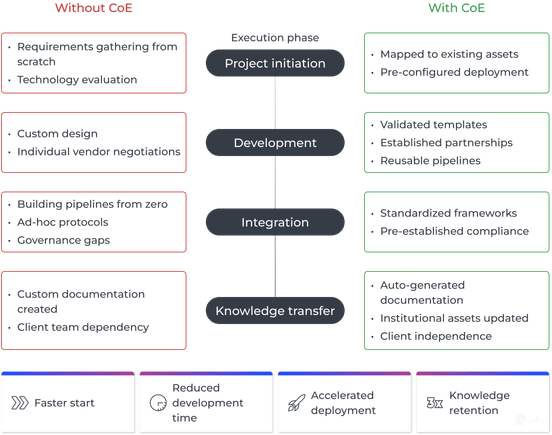
Without a cohesive tissue of a CoE, innovation remains artisanal. Every new project begins with a cold start because teams have to reinvent core elements, re-architect MLOps pipelines, and recreate security protocols that were already production-hardened in previous months. When stakeholders ask What is an AI CoE in a mature enterprise, the answer is simple: it’s the institutional memory.
In the absence of a shared delivery spine, knowledge exists only in the minds of certain engineers, creating high-risk silos. Quality becomes a variable of who is assigned to the ticket, rather than a reflection of the organization’s standard.
For companies working with diverse AI domains, a CoE is the most reasonable mechanism for maintaining coherence across a growing AI portfolio. It lets teams build high-leverage capabilities once and compound value across projects. To be specific, a dedicated Center of Excellence model benefits in the four areas:
- Reusable assets and accelerators: validated model blueprints, prompt engineering libraries, data pipelines, and any artifacts that speed up delivery from concept to code.
- Established quality standards: a unified definition of what done work looks like in terms of security standards and adversarial testing.
- Talent development pathways: structured upskilling that ensures your engineers move as fast as the state-of-the-art.
- Strategic portfolio management: a mechanism that evaluates initiatives based on value, technical feasibility, and resource requirements to invest time and effort in higher ROI opportunities and avoid taking on low-impact experiments.
As many as 37% of US-based businesses have already established AI CoEs, recognizing the increasing importance of AI initiatives coordinated at a portfolio level.

AI CoE Architectures: Learning from Technology Leaders
Industry leaders demonstrate that an AI Center of Excellence reflects a company’s primary commercial mission. Having examined the execution playbooks top-performing tech companies employ, we can separate three distinct operational models.
NVIDIA: The Infrastructure Architect
NVIDIA’s CoE operates on a singular premise: the belief that perfectly synchronized hardware-software architectures are the only way to meet the demands of modern AI. Their AI CoE framework aims to dissolve computational bottlenecks that degrade model training efficiency and inference latency. It emphasizes the following aspects:
- Validated reference architectures
- Performance benchmarking protocols
- Infrastructure telemetry and monitoring
NVIDIA provides the “pipes” and blueprints that the rest of the industry runs on, largely thanks to their CoE.
Their model benefits the industrialists of the AI world, whose operations hinge on mission-critical compute power and seamless data throughput. We see this in R&D labs developing cutting-edge models, autonomous vehicle companies processing sensor data in massive volumes, and drug discovery platforms running molecular simulations.
IBM: The Governance Guardian
IBM’s WatsonX platform shows fundamentally different CoE guidance principles. With the full application of the EU AI Act in 2025-2026, IBM has pivoted its CoE to concentrate on explainability and trust. Their model simplifies the rollout of AI for public-sector bodies and regulated private enterprises carrying decades of technical debt and compliance requirements. The core mechanisms seen in their approach are:
- Model lineage tracking and documentation
- Bias detection and mitigation protocols
- Explainability tooling
An AI governance framework that IBM uses proves essential for heavily regulating industries where model transparency carries equal weight to predictive accuracy.
Palantir: The Operational Accelerator
Palantir’s philosophy highlights another common AI-related constraint — breaking down the data silos that typically paralyze enterprise intelligence. Their CoE model optimizes for deployment velocity and user accessibility, aiming to get AI tools into the hands of frontline workers in defense, healthcare, and logistics domains within weeks.
The company’s recent launch of an agentic forward deployed engineer is one more step in this direction. It allows human-AI teaming to happen directly inside operational workflows. We can extract the following design principles from their framework:
- Federated data integration
- Role-based application templates
- Operational feedback loops
These three models, which are completely different yet effective, reveal that the structure and design logic of the Artificial Intelligence Center of Excellence depend primarily on the business context. The creation of Quantum’s framework was ruled by exactly these lessons learned.
Quantum AI Center of Excellence Framework
We aren’t NVIDIA, IBM, or Palantir in sheer headcount. But size has never been the defining factor in disciplined execution. Systematic structure is what allows delivering AI solutions with sustained, enterprise-grade consistency, and that’s why we’ve built a dedicated Center of Excellence.
While the majority of organizations leave value on the table through inconsistent quality and duplicated effort, repeating from project to project, our AI Center of Excellence framework addresses the missing coordination of AI development. With CoE, our team can work on multiple AI and ML use cases simultaneously, build with precision, and, most importantly, deliver measurable value that survives the transition from lab to production.

The Two Pillars of Predictability
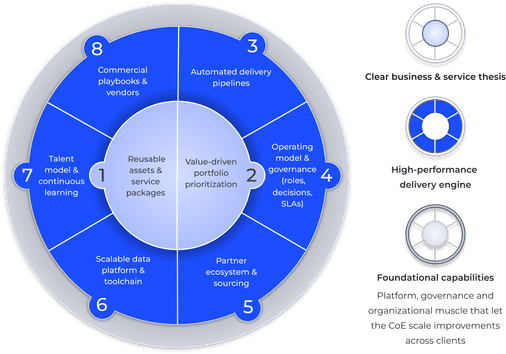
At the heart of our framework lie two foundational elements that turn technical potential into commercial momentum.
Pillar 1: Reusable Assets and Service Packages
While consulting firms start each engagement by rebuilding from scratch, we productize them.
Our asset library consists of validated ML models, data pipeline templates, and solution blueprints that accelerate project initiation by 40-60%. Then we adapt time-tested architectures for the unique requirements and data schemas for a particular company operating in a certain niche.
We applied this approach to our cooperation with a Swedish company that needed an invoice processing overhaul. We reduce document analysis time by deploying validated NLP models and workflow templates.
“The value of the CoE asset library is not only in the ability to accelerate development, but make outcomes predictable. When you know exactly which components work for certain problem classes, you eliminate the high-variance outcomes that make AI consulting feel like gambling,” explains Aleksandr Dolgaryev, Quantum’s CTO.
Pillar 2: Portfolio and Value Optimization
Not all AI is worth realizing. Our CoE evaluates projects through three lenses: strategic value to the client, ROI potential, and technical risk profile.
Following these rules, we avoid jumping into shiny-but-shallow projects that consume resources and crowd out higher-return opportunities. The framework also balances client delivery commitments with IP-building investments that strengthen our asset library for future engagements.
6 Enabling Sectors
The two pillars rest on six operational sectors that transform strategy into delivery capability.
Sector 1. Automated Delivery Pipelines
Standardized pipelines we leverage manage data ingestion, model training, testing, and deployment with minimal manual intervention, serving as the main enabler of rapid model promotion into production.
Typically, we use APIs to integrate pipelines with client systems, reducing integration friction that extends timelines by 30-40%. When deploying predictive models for an oil and gas exploration company, automated pipelines enabled us to move from prototype to production 3x faster.
Sector 2. Operating Model and Governance
We establish clear roles, decision rights, and SLAs to eliminate the who does what confusion that kills velocity. Our governance structure clarifies who approves model changes, how data quality issues are documented and resolved, and which stakeholders review deployment decisions. It proves particularly valuable for clients in regulated industries like healthcare.
Sector 3. Partner Ecosystem and Sourcing
Our CoE maintains relationships with data providers, API vendors, and pretrained model suppliers to augment our internal capabilities. Thanks to strategic partnerships, we can provide faster project initiation and more economical delivery. For example, for a multilingual customer support platform, the decision to integrate Google BERT models cut remarkably development costs.
Sector 4. Data Platform and Toolchain
Our platform supports model versioning, drift monitoring, and automated retraining — capabilities that prevent deployed models from degrading over time. This MLOps infrastructure operates across cloud providers and on-premise environments, allowing our clients to align with data sovereignty requirements while leveraging services for compute-intensive workloads.
Sector 5. Talent Model and Learning
Our talent framework creates career progression paths and competency development systems that keep engineers current with emerging techniques. Cross-training programs ensure multiple team members understand each client’s systems and business context, so no single talent becomes a bottleneck in the project’s progress.
Sector 6. Commercial Playbooks
Unified contract templates and pricing models shorten negotiation cycles and establish clear expectations for everyone. Our playbooks define intellectual property ownership and liability boundaries, along with performance guarantees. Establishing these baselines is vital as it removes friction from client relationships. When executives know what they’re purchasing and how success gets measured, projects move faster from approval to implementation.
Three Layers of Excellence
To see the full picture, you have to look at how these sectors stack into three thematic layers:
Layer 1. Business & Service Thesis
First of all, our CoE investments are guided by real-world client demand, ensuring we never build impressive technical capabilities for their own sake.
Layer 2. High-Performance Delivery Engine
This How layer provides the repeatable patterns, specialized workflows, and performance KPIs that let us move 10x faster than manual workflows.
“Most AI development fails at the delivery point,” notes Dolgaryev. “Teams have great ideas and solid tech skills, but they lack the operational discipline to deliver consistently. That’s where systematic process separates professional services from hobbyist experimentation.”
Layer 3. Foundational Capabilities
Platform, governance standards, and organizational discipline enable CoE to scale improvements across multiple clients. When we develop a better approach to data quality validation, that improvement spreads to all current and future projects.
Building this framework took significant investment in tooling and process development that don’t appear on client invoices. We spent years refining our CoE-backed services across dozens of implementations to provide better outcomes and faster delivery.

Final Words on AI CoE Advantage
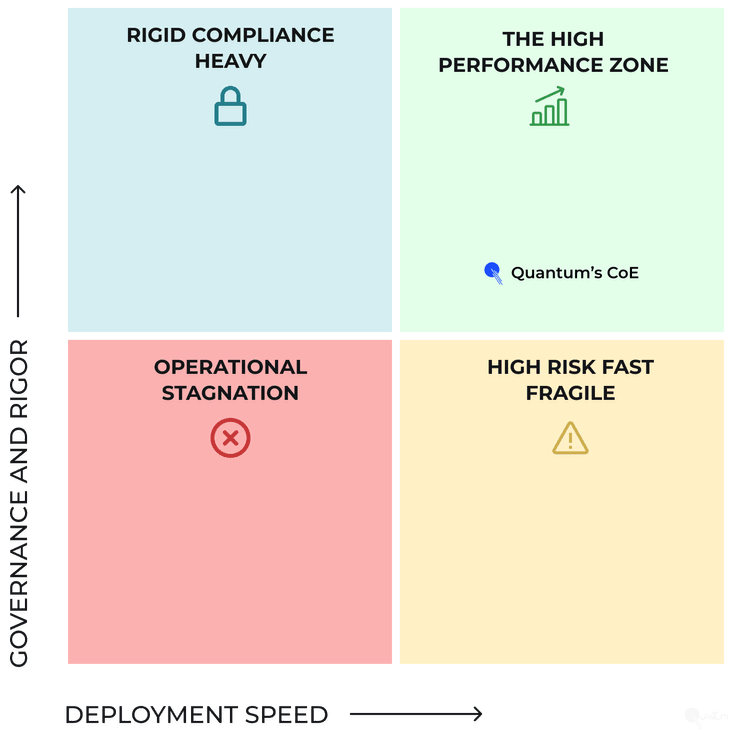
All in all, the advantage of an AI boutique company lies in agility backed by an ironclad structure, implemented via an AI Center of Excellence. A dedicated CoE transforms AI from a series of fragile experiments into a robust commercial lever. By industrializing AI portfolio management, it becomes possible to achieve:
- Predictable velocity
- De-risked innovation
- Compound value
And that’s not all. While the market is flooded with plug-and-play promises, Quantum offers the systemic backbone necessary for true sector dominance.
Center of Excellence
Gain high-value, production-ready AI solutions through a standardized and governed framework that moves initiatives efficiently from experimentation to scalable, compliant deployment.
Check the service